Updated Feb. 2019
 Eagle's Nest, '03
[View from Hobert's front porch]
"Mountain Voices," 2007
Followed by "Collected Quotes"
Click on March 1 to access, "salt & truth," materials.
_________________________________
Followed by "Collected Quotes"
Click on March 1 to access, "salt & truth," materials.
_________________________________
"Mountain Voices"
Interviews, quotes and comments by my friends, subjects and families.
Interviews, quotes and comments by my friends, subjects and families.
Introduction
Why post this? Perhaps I needed to confirm for myself how my subjects really feel. I learned a great deal from these interviews; how my people experience and value photography, their own culture, its diversity and my relationships to them. Will this make a difference to you as viewers of my work? I hope so. I remember what my friend Hort Collins once said, “It’s only what you thinkin’ is what you see,” published in "Appalachian Lives," 2003.
Shelby Lee Adams
_____________________________________________
10 Interviews from 2007- Mountain Voices
Hobert White Interview:
Hobert White: We have known each other for five years. Hobert is the father of Cody, in photo "Cody and Tank, '04." His family lives in the head of a hollow called Eagle's Nest. Hobert has helped me make several photographs in his community.
Shelby: What do pictures mean to you and your family?
Hobert: "You see a generation of people that no longer exist. When you go to the heads of these hollers those people still preserve the old ways. They do things the way we done'm 30 to 40 year ago. They's people that hang true to that. The pictures that you take, when I first saw them, they automatically take me back to my childhood, that old plow, that wall paper made out of old newsprint, the fact that they are black and white, that brings back happy memories to me, yet they are of today, too. The good part of it to me is the memories. Pictures are good memories, past and present, and good for our children's future."
Shelby: Do you see poverty in my pictures?
Hobert: "There is no poverty to us; we're rich in what we have and do. OK, so we don't have a lot of money, we don't have big fine cars and fine homes. We have tradition, we're rich in culture.
I can take someone from NYC and bring them here and they would starve to death, because they don't know here. They don't know how to survive, how to preserve food, garden, canning, how to get buy from the land. That's what we do. It's not just a culture past; it's a way of life now. It's our way of life. I wouldn't trade this, my way of life for anything that anybody in NYC or anywhere has."
"I was raised to this, I was taught this by my grandfather and father."
"It's mine."
"An outsider already has an idea of what they think about me before they meet me or hear me speak. They see your pictures different than I do to. You look at "The Hog Killing, '90," picture, that makes me think, my memories come back, I could feel the cold mornings from my childhood, in the dark and having the water on the fire boilin' before daylight, we killed the hog, the neighbors come over and what a time we had, we was scrappin', workin', it was an event, we made cracklin's, history, that's what it is. These pictures are life. That's fantastic; no one had to tell me that. That meat from your makin' that photo fed those families for three months, we know that, ain't no stagin' to that, that's good as we see it. You don't try and paint no picture that's untrue. There's a life that's goin', but I can still look at 'em and still recall it in your pictures. We have culture, that's what that picture is about and that means everything."
"I haven't known you that long, but I know who you are. We have a sense about us here and we know whether or not, you're lookin' at us as some poverty stricken little poor feller. We know. I see a culture that's dying in your pictures. I see a way of life that's dying that may no longer exist. It's important what you do."

Cody and Tank, '04
"If you sold my son's picture for a million dollars tomorrow that would be great, because we have one of the pictures in our home and we are proud of it. If you have to pay someone to take their picture, then it's fake."
"Kentucky is a divided state. The wealthy think what you're showin' is only the bad, but - what they don't understand is you're only showin' the good. You're showin' life here at its beginin', when it was simpler. Without those holler dwellers as you call them, there wouldn't be those big fine people today. They the ones who ridicule us today, because they're ashamed. They wish we didn't exist. Without us, they wouldn't be them.""People should get to know us before they judge us, they should get to know you and what you about first. They's a history behind it. You preserve my way of life. If the people you photograph, don't complain, no body else has a right to, it's our way of life. We ain't up tight about who we are. I'm proud of who I am. We are a proud people. We don't want to be disrespected and you're not."
"Kentucky is a divided state. The wealthy think what you're showin' is only the bad, but - what they don't understand is you're only showin' the good. You're showin' life here at its beginin', when it was simpler. Without those holler dwellers as you call them, there wouldn't be those big fine people today. They the ones who ridicule us today, because they're ashamed. They wish we didn't exist. Without us, they wouldn't be them.""People should get to know us before they judge us, they should get to know you and what you about first. They's a history behind it. You preserve my way of life. If the people you photograph, don't complain, no body else has a right to, it's our way of life. We ain't up tight about who we are. I'm proud of who I am. We are a proud people. We don't want to be disrespected and you're not."

Hobert and Cody, 2013
[target practicing with 44 Mag.]
Hobert White
Eagle's Nest
_____________________________________________________
Rachel Riddle Interview

Rachel and Family, 2006
[Rachel standing in middle with her bedfast son, whom she has cared for at home for 15 years, three generations of family in photo.]
Rachel Riddle: Rachel and I have known each other since 1983. She and her family have helped me with my work now for over 25 years. The Riddles pose for pictures, help educate me to their religious and cultural beliefs and provide personal introductions to neighbors and church groups. Rachel's children have traveled with me as my photo assistants on many occasions.
Shelby: What do pictures mean to you?
Rachel: "Pictures? Pictures mean you've got photographs of your loved ones, your fore-fathers. You can look back and see what was, when younger. It's part of our history and you wonder back and imagine what they would look like today if they had lived now and what they might think of in today's time. Pictures, they mean a whole lot."
Shelby: In general, I know you and your grandchildren have been reading sites about me and my work on the Internet. I know you want to address some of these issues.
Rachel: "Shelby, you have been coming in here for so long. You find people in need, you take there pictures, you always help them, you ask for their permission to use their pictures, you're always clear about that. And another thing, you never take without giving. There is no exploiting."
"I remember when in 1990 you came in here with two of your students to take pictures. Our stove had just broke', I had no way of cookin' for our children. You didn't ask any questions, you just said, go get you a stove, pick you out one and I'll buy it. You were here to take pictures and helped us out in the mean time. Shelby, you have helped over the years in more ways than you ever imagined - Christmas, Thanksgiving, gas money - you just don't know. Shelby, you not out there exploiting, you showin' the country in these museums and places where you come from. Some people live here the way they live, it's their own choice. Many do. It's not about poverty."
Shelby: What do pictures mean to you?
Rachel: "Pictures? Pictures mean you've got photographs of your loved ones, your fore-fathers. You can look back and see what was, when younger. It's part of our history and you wonder back and imagine what they would look like today if they had lived now and what they might think of in today's time. Pictures, they mean a whole lot."
Shelby: In general, I know you and your grandchildren have been reading sites about me and my work on the Internet. I know you want to address some of these issues.
Rachel: "Shelby, you have been coming in here for so long. You find people in need, you take there pictures, you always help them, you ask for their permission to use their pictures, you're always clear about that. And another thing, you never take without giving. There is no exploiting."
"I remember when in 1990 you came in here with two of your students to take pictures. Our stove had just broke', I had no way of cookin' for our children. You didn't ask any questions, you just said, go get you a stove, pick you out one and I'll buy it. You were here to take pictures and helped us out in the mean time. Shelby, you have helped over the years in more ways than you ever imagined - Christmas, Thanksgiving, gas money - you just don't know. Shelby, you not out there exploiting, you showin' the country in these museums and places where you come from. Some people live here the way they live, it's their own choice. Many do. It's not about poverty."

Wayne's Serpent Bite, 1990
[Rachel and Wayne Riddle, after Wayne's release from hospital.]
“There are people among us who choose not to embrace modern life. They want to stand on their own two feet. These people won't sell out to get rich, but they don’t really go without. They have their values and principles they were raised by and they think that is worthwhile. The riches and ways of the world don’t matter to them. They are basically Christian people who home school their children mostly, they put their dollar to good use and they help their neighbor. They wouldn’t work at WalMart for 40 hours a week because they wouldn’t want to be exposed to the world of bikinis, video violent games and movies, makeup, and such. They would rather work at home in the mountains for 60 to 70 hours a week and feel closer to God and their own values in life.
They grow herbs, raise stock, garden, and work labor jobs like most of us, but more independent. They believe you stay present in the Lord; he doesn’t change. His heart is the same in the past, the present and the future. To stay in the ways of the Lord is to stay away from modern ways for these people. They are a hard workin’, happy and fulfilled people, ain’t grabbin’ for ever nickel they can get.”"People off from here don't want to see how poor whites live, they not black people lookin' either. We have a lot of millionaires living here now, I don't understand it. I know one thing, since I been puttin' my Lord first for me, I've not really wanted for too much. The Lord provides for my family, and me. He makes a way for us. We not worried about a big lot of money."
"People who come in here with you, taking your hospitality, that you offer. We tried to help them and then they used every bit you gave to turn against you. They speaking evil of you; you don't speak evil of them. They are exploiting you. Why would they want to do that? Envy and strife."
"I've studied the films on TV, the poverty in India, Africa and such. There is more poor in the world than rich. All our forefathers were probably as poor as we come from, maybe worse. They's some people, they get away from home, they change the way they talk. They talk proud, deny there background. Mountain people do that, too. They're ashamed of their background, maybe that's what's the matter. Some are ashamed of their backgrounds and coming against you. You're trying to deal with yours and help yours."
"How else could you help them? You sell pictures, you send back money to the people you deal with, you visit 'em twice a year. Do other photographers do that? They never come back and thank us for our help in their pictures and films, or nothing. You have always kept in touch, visited and helped people. You can put a letter on the Internet to what I say."
Shelby: In my first book, "Appalachian Portraits," 1993, your pictures are published twice. In the same book one family photograph is published of a man who is mentally and physically impaired. Would you comment on that photograph?
Rachel: "You don't hide anything, it's part of your life. You should love a child or family member no matter what his shape. That child needs encouragement. They will get to where they don't care if they live or die without encouragement. Showing them in a book is a way of giving love. They're your blood and you love them regardless of what the world might think. It shows to them and their families they're worthy."
Shelby: So you're OK with being published in a book with a family reflecting some difficulties and you don't feel stereotyped?
"People who come in here with you, taking your hospitality, that you offer. We tried to help them and then they used every bit you gave to turn against you. They speaking evil of you; you don't speak evil of them. They are exploiting you. Why would they want to do that? Envy and strife."
"I've studied the films on TV, the poverty in India, Africa and such. There is more poor in the world than rich. All our forefathers were probably as poor as we come from, maybe worse. They's some people, they get away from home, they change the way they talk. They talk proud, deny there background. Mountain people do that, too. They're ashamed of their background, maybe that's what's the matter. Some are ashamed of their backgrounds and coming against you. You're trying to deal with yours and help yours."
"How else could you help them? You sell pictures, you send back money to the people you deal with, you visit 'em twice a year. Do other photographers do that? They never come back and thank us for our help in their pictures and films, or nothing. You have always kept in touch, visited and helped people. You can put a letter on the Internet to what I say."
Shelby: In my first book, "Appalachian Portraits," 1993, your pictures are published twice. In the same book one family photograph is published of a man who is mentally and physically impaired. Would you comment on that photograph?
Rachel: "You don't hide anything, it's part of your life. You should love a child or family member no matter what his shape. That child needs encouragement. They will get to where they don't care if they live or die without encouragement. Showing them in a book is a way of giving love. They're your blood and you love them regardless of what the world might think. It shows to them and their families they're worthy."
Shelby: So you're OK with being published in a book with a family reflecting some difficulties and you don't feel stereotyped?
Rachel:"That makes me feel proud that Shelby feels enough for them, for other people, regardless of their shape or form. To put their picture in the book shows respect of people regardless of color, race or situation. We don't put down people because they are made different or act different from the rest of us. Jesus healed all peoples. Some people don't understand our culture, they tryin' always to get above us. Down through the ages and years, all peoples come across this, whether they admit it or not. Mountain people are more honest. Yet, half our people bring forth such children and the other half hides it in shame."


Rachel holding her family photo at cookout in 2008.

Most of the Riddle Family, 1987
Rachel Riddle
Viper
_____________________________________________________
Viper
_____________________________________________________
Phyllis Turner Interview
 Sara mpFryff; Fry, '99
Fry and Sarah, 1999 [Phyllis's daughter's]
Phyllis Turner: Phyllis was a high school photo assistant for me during her high school summer years. I photographed her wedding. She's married now with two children attending high school. We have known each other for over 25 years.
Shelby: What do pictures mean to you?
Phyllis: “Pictures represent the past, the future and the hope; the hope of someone dear that’s gone on. You can see them held in pictures. Something you can pass on to future generations so that they will know their ancestors. Because some of us that can’t write or read, we can show pictures and tell stories. Pictures can do more. It’s somethin’ that stands. When their face starts gettin’ blurry from memory, with pictures you can always see them. It always brings back happy memories. There are sad memories, but there are always happy memories. There's times a story comes up from each picture you’ve got. Sometimes the story might be sad or funny. I’ve got somethin’ in pictures. I’ll always be able to cherish. Where we can’t afford pictures, you help us to see how our youngin’s is growing throughout the years, how we grow through the years. How some of us have changed throughout the years. Some got new homes-you show that as well as the old. To me you are photographin’ pride, you're proud of who we are, you're proud of us, you're one of us and you're proud of bein’ with us and you're wantin’ other people to know that were not just someone sittin’ back here like on that show the 'Beverly Hillbillies.' You're proud of us even tho’ you live in Massachusetts.”
Shelby: Can you speak about my photography in general terms?
Phyllis: “You’re not ashamed of us and we are proud of you. When you are out there in them big cities you're showin’ you are proud of us to, to us. If some weren’t ashamed of their culture so much, they wouldn’t fight you on yours. My youngin’s show your books in their school and library, they're proud to say they know you. My daughter was in NYC on a high school trip five years ago and she saw a book display of your work. It made her proud and she told her friends.”
“We feel your work comes from the heart. You think we would let you through our doors and in our homes when it’s a mess and not so clean, if we thought you were exploiting us? You’re like part of the family. I’ve taken you to meet many mountain families. I couldn’t do that if I thought you were here to ridicule. What ain’t showed by you is just as important as what is. People don’t understand we trust you. My interview was never showed on TV [Canadian Film, 2002]; guess I didn’t say what they wanted me to say. Where is my part in the movie and other people we know? They got people lookin’ at only what they sayin’ and that’s it. They lied to us; same with the Internet. We're poor but we are a proud people. We stand together in times of trouble."

Fry and Shelby, 2010
[Photo by Sarah]
Phyllis Turner
Beehive
___________________________________________________
Roy Banks Interview
Beehive
___________________________________________________
Roy Banks Interview
 Roy, '03
Roy Banks: Roy has been a special friend for over 25 years, a country musician, folklorist, hat maker, scout for my photographs and companion who plays music for my subjects, while I’m preparing to photograph.
Shelby: What do pictures mean to you?
Roy: “Pictures shows what it’s been like many years back, and today. It’s really a great thing. You have done things that others would never attempt to do. You love the people, that’s my feelin’. You're tryin’ to do somethin’ for 'em. Capture the spirit of people.”
Shelby: Would you make some additional comments?
Roy: “ I’ve watched you work with people many times. You know how to do it, put people at ease and bring them out. I do that in my music. You got to watch the people and bring them out, in a good way. They’s jealousy by them that want to get ahead of you. They think that they're better than you. They want to accuse you of something to get you to quit what you are a doin'. There is no need of quitin’, when you're doin’ somethin’ good. They’s people that want to discourage you, Shelby. They’s a lot of people like that. They know they can’t do what you're doin’, because our people won't talk to em’. Where you love everybody, those people, you can figure 'em, they don’t care for nobody but themselves. You got to have pay for your work, so you can keep doin’ it."
Roy: “ I’ve watched you work with people many times. You know how to do it, put people at ease and bring them out. I do that in my music. You got to watch the people and bring them out, in a good way. They’s jealousy by them that want to get ahead of you. They think that they're better than you. They want to accuse you of something to get you to quit what you are a doin'. There is no need of quitin’, when you're doin’ somethin’ good. They’s people that want to discourage you, Shelby. They’s a lot of people like that. They know they can’t do what you're doin’, because our people won't talk to em’. Where you love everybody, those people, you can figure 'em, they don’t care for nobody but themselves. You got to have pay for your work, so you can keep doin’ it."
“The big shots are greedy, jealous. They're afraid you can do things that they can’t do. You goin’ to have some bad people. When I went up North, man they was after me. They ask me if we had any crazy people in Kentucky. I said sure, we handle them people, we send them up here to teach in your schools. They give me a hard time, but I give them a hard time, right back. They don’t think like we do.”
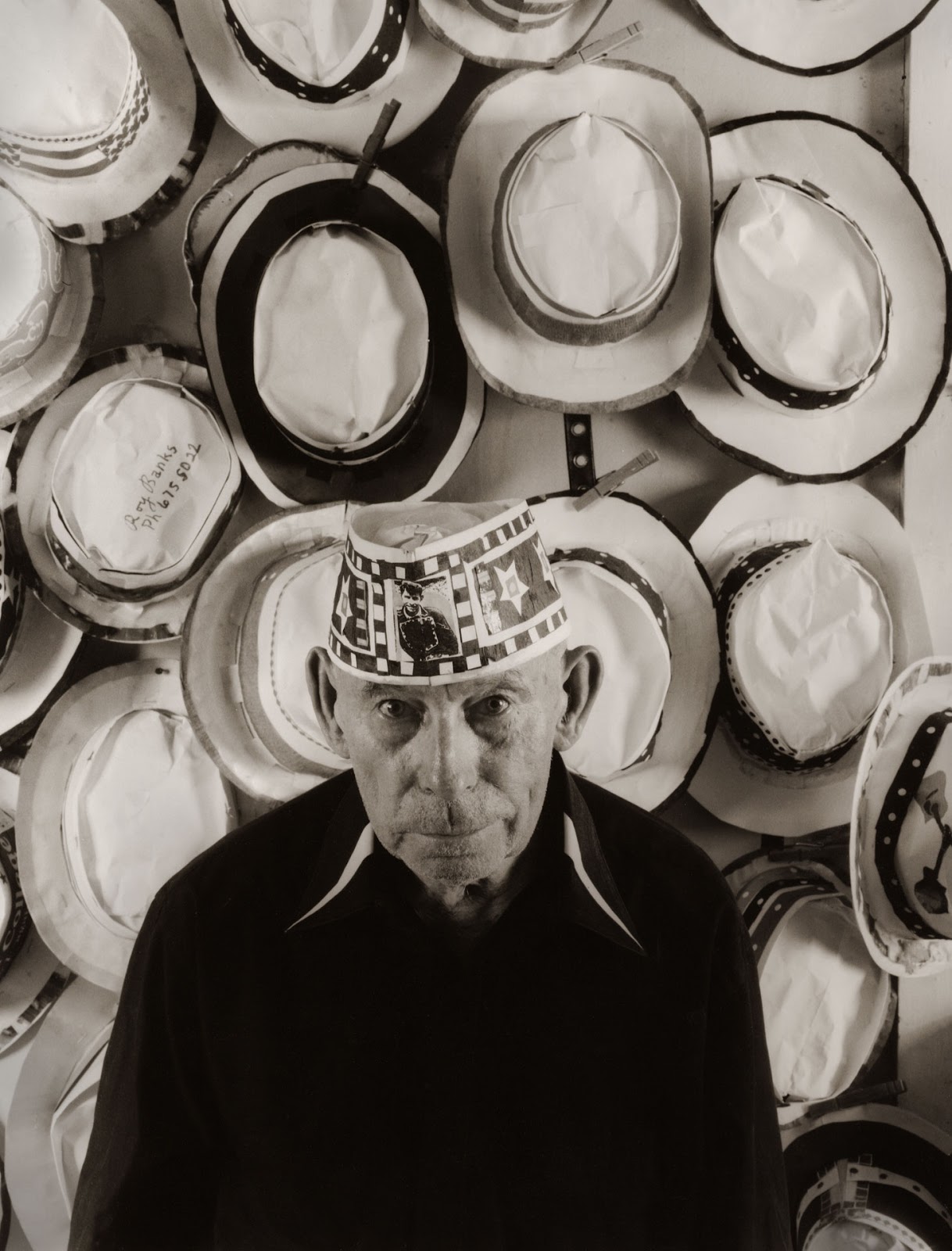
Roy with Paper Hats,'07

Roy at age 80 holding a one month old baby.
[Roy died one month after this photo was made]2013
Roy Banks
Slemp
___________________________________________________________
Martha and Kizzie Joseph Interview
 Kizzie and Martha, '07
Martha and Kizzie Joseph: Phyllis Turner introduced me to the Joseph family in 1986. Kizzie [blindwoman] and I became fast friends. My own childhood memories resurface of my grandmother’s struggle with blindness when I was a child. My grandparent's home place and Kizzie’s family home were similar. Visiting with the Joseph family is like revisiting parts of my childhood; it feels anchoring, autobiographical, yet now I visit with my view camera.
Shelby: What do pictures mean to you?
Martha: “Pictures mean a whole lot, when you can see them and not the people; especially the ones gone. They bring back a lot of memories, but they help my feelin’s. They make me feel real good. It brings back more life in my memory when I was growin’ up and they make me feel better. You photographed my Dad before he died. Mother really liked you 'fore she died; brothers Richmond and Charlie, they died. Your pictures remind me of my life, even before I knowed you. When our house burnet’ down last year and you give us another book with our pictures in it, Lord that’s the world of memories in that."
“My mother was brought up in Holiness. They had something we didn’t have. They would get happy [anointed] in the spirit. The Holy Ghost could tell you if things were real and if they weren’t. My mother always thought a lot of you.''
“My mother was brought up in Holiness. They had something we didn’t have. They would get happy [anointed] in the spirit. The Holy Ghost could tell you if things were real and if they weren’t. My mother always thought a lot of you.''
Shelby: What do pictures mean to you?
Kizzie: “Your picture takin’ makes me feel good, it’s nice. You’ve always been a good friend to us. Marthie and me talk about pictures a lot, she gets them out and she talks about them pictures to people and me. It’s good we got pictures of everyone, but sad they're gone.”
Shelby: Kizzie, people who see my pictures of you and know you are blind ask, why do you wear a watch and glasses?
Kizzie: “Wearin’ glasses helps me feel better about myself and I love to hear a watch tick."

Martha and Kizzie holding, "salt and truth,'' open to their photos.
[Summer 2012]
Martha and Kizzie Joseph
Wolf Creek
__________________________________________________
Lloyd Dean Noble Interview
__________________________________________________
Lloyd Dean Noble Interview
 Reed with Pony,'95
[Lloyd Dean's Father]
Lloyd Dean : Lloyd is the father of 10 children, over 45 grandchildren and 10 or 12 great grandchildren. He is my personal friend who knew my uncle “Doc Adams." His entire family have been my photo subjects since ’89. Many of the Noble photographs were published in my third book and many more are currently in my new book dummy; this family has participated in interviews with "The New York Times" in ’03 for their series, “What were they thinking?” and most recently "The Louisville Courier-Journal," a Summer ’07 article and photo portfolio, among others. Lloyd and his family has provided extensive interviews for many other media projects. I have photographed the Noble family now for four generations; our work continues.
 Lloyd Dean with Family and Coal Truck, '02
Shelby: Lloyd, we know each other so well, would you care to speak on exploitation around my work?
Lloyd: “Well you not exploitin’ nobody, we just like one big family. That’s the way I look at it. We have been that way since you have been coming down here. I don’t like for nobody to expose on you, to run you down. You’ve got to put money in this camera stuff. You work hard, it costs. The devil persists. You honest to people, you help people, you bring the pictures back and you show 'em to 'em. Give 'em to 'em. I think you’ve done a great job of what you do. Jealousy - that is exactly what it is - jealousy. You a showin' the whole world what you doin', a makin’ these pictures and stuff and helpin’ people and donating to 'em. Nobody has done what your doin’. I’d say it comes from your uncle.”
“I knew your uncle “Doc Adams." He was my friend and doctor. I tell you some'in' on him. He doctored a lot of people and he wouldn’t take a dime. He was good to people, old people and children. That’s one thing, he’s on the side of heaven, has to be. I went to his funeral, I looked at his casket and buddy, it tore me all to pieces. They were over 2,000 people at his funeral. He loved people, just like you do. People want pictures of you in with them, because they love you so good and they want people to know it. You take a jealous person and they ain’t got the love in them enough to realize what love and friendship is with these old mountain people. I drove an 18-wheeler truck for years for miles and miles around this country as a truck driver and I’d get lost. People help you get around, if you’ve got love in your heart."
“You take us old hillbillies, we poor but you don’t pick on the person who is tryin’ to help. You sell pictures to rich people, they must be moved by somethin’. They ain’t goin’ to see our lives no other way! That is important to us. I don’t understand that anything’s wrong."
Shelby: How do you feel about having your family pictures published in my book with others who might have physical and mental disadvantages?

Lloyd Dean with Great Grand Baby, 2010
Lloyd: “Well sir, you ought’ to have love and respect to help people. I’m proud of it. We’re all raised in these old mountains and it helps that family to have their pictures in your book. It shows to me and my family, you’ve got love and respect for that family to help them that way. It’s plain as 'A, B, C' if you look at it right. We, too, are a divided people in a way. You have the rich here, the 'locked-up-door' types, and us, who are open, like you who are friendly trying to help the people."
Shelby: Do you think any of my photos are scary as some critics imply?
Lloyd: “They ain’t any scary pictures, as I see it. You look at a picture like them two youngin’s together, I see two children who need more of God’s love and our love. They make me say a prayer and then I turn over to my boy’s pictures and say another prayer of thankfulness. Your pictures make us feel love, prayer and respect. I feel plum' good on both sets of pictures. Shelby, the Lord will bring you out of this.”
 Vanessa, '07
[Lloyd Deane's Great Granddaughter]
Published in The New York Times,
Cover - Week in Review - April '08,
Published in The New York Times,
Cover - Week in Review - April '08,
salt 7 truth, 2012
Lloyd Dean Noble
Hard Shell Canie Creek
Lost Creek
_____________________________________________________________
Burchal Hurt Interview
 This Question,'91
[Burchal and Son, BJ.]
Burchal: We have known each other since the mid 80s, Hort Collins, religious Zealot, now deceased, was our close friend. We attended Hort’s home church together. Burchal is a father; I have photographed his son BJ growing up for over 20 years. Burchal is a retired school bus driver and currently a security guard for a mining company.
Shelby visits with photo assistant: Burchal, could you say something about our relationship and my photography here in Hooterville?
Burchal: “I’m plain to anybody right to their face: Shelby’s not took a picture in this holler, what I’ve not seen, and I probably have a copy of.
I think he’s done real well. From my way of lookin’ at it, places like Hooterville is where they ought to be [filming] puttin’ films on TV today. Maybe others that’s got a lot, could see to help others here “like."
The wealthy living on the tops of mountains "like,'' need to see here "like". A poor man can’t get nowhere here. It’s like they don’t see you when it comes to goin’ before a judge to ask for somethin’.
It means a lot for me to have pictures Shelby’s made, especially now after so many family and friends have passed. I remember him showin’ me that picture of Hort and Henry prayin’ [The Brother’s Praying,‘93-below] when their mother was sick. He showed me the Polaroid of it then. He was pleased with it, we all were, and then Mimi died [Hort’s mother]. It seems to me that our times together and friendship is important, with memories together of those now gone is special times. The pictures are second, but the pictures show both.”
I think he’s done real well. From my way of lookin’ at it, places like Hooterville is where they ought to be [filming] puttin’ films on TV today. Maybe others that’s got a lot, could see to help others here “like."
The wealthy living on the tops of mountains "like,'' need to see here "like". A poor man can’t get nowhere here. It’s like they don’t see you when it comes to goin’ before a judge to ask for somethin’.
It means a lot for me to have pictures Shelby’s made, especially now after so many family and friends have passed. I remember him showin’ me that picture of Hort and Henry prayin’ [The Brother’s Praying,‘93-below] when their mother was sick. He showed me the Polaroid of it then. He was pleased with it, we all were, and then Mimi died [Hort’s mother]. It seems to me that our times together and friendship is important, with memories together of those now gone is special times. The pictures are second, but the pictures show both.”
 "Brother's Praying," '93
[Hort and Henry Collins]
Seeing
"People walk the roads, but they can’t see.
“It’s’’ what anybody’s thinkin’ about, when they see somethin’.
“It’s” only what you thinkin’ is what you see."
Hort Collins - Hooterville
Burchal Hurt
Hooterville
_________________________________________
Terry Riddle Interview
Terry Riddle Interview

Freddie's Place,'04
Terry Riddle: Age 33, Terry and I have known each other since Terry was 9 years old. Father, husband, and church member, he has worked in coal mining most of his life. Terry has traveled with me intermittently in Kentucky. visiting and photo assisting, throughout most of the counties I work.
Shelby: What do you have to say about my work here?
Terry: “You’re showin’ our way of life, We ain’t 'The Clampets' any more. You’ve made yourself clear. People have enjoyed the pictures. People enjoy seein’ you come around, you are more than just a person, and you were and are a friend of the families around here and that is the way they have looked at it and that is the way I look at it. You keep comin' back. You ain’t just tryin’ to make a name for yourself, and you ain’t just a face, just a fly by night. You keep comin' back, that is the most important thing. Year in, year out, you keep comin’ back, that is important to people."
“Your pictures, they are about culture, showing how different people live, how one person is just different than another.
You got to learn how to deal with all people. It’s just like black people and white people. You know some racist, they look at it different. Not me, I look at it totally different. That’s what your tryin’ to show people, to me. That’s a part of our church and everything here, in Eastern Kentucky, about God. There’s love and kindness in all things and take a man, as who he is.
I’m more accepting of all peoples, denominations in church, races and whatever you want to call it. I see good in all people. I’ve seen your ways, from growin’ up under you; you’re tryin’ to teach people. I’ve watched you. You're showin’ they’s somethin’ good in all of us, as individual people. It don’t take a well knowledged' person to understand the feelin’ of love and kindness, when you see it in someone and their works, you feel it.”

You got to learn how to deal with all people. It’s just like black people and white people. You know some racist, they look at it different. Not me, I look at it totally different. That’s what your tryin’ to show people, to me. That’s a part of our church and everything here, in Eastern Kentucky, about God. There’s love and kindness in all things and take a man, as who he is.
I’m more accepting of all peoples, denominations in church, races and whatever you want to call it. I see good in all people. I’ve seen your ways, from growin’ up under you; you’re tryin’ to teach people. I’ve watched you. You're showin’ they’s somethin’ good in all of us, as individual people. It don’t take a well knowledged' person to understand the feelin’ of love and kindness, when you see it in someone and their works, you feel it.”

Terry at Guggenheim Party 2010
Terry Riddle
Lewis Hollow
_______________________________________________
Darrel and Arch Napier Interview

Darrel and Arch, '07
Darrel and Arch Napier [brother’s]: We have known each other since the mid 80s; I have photographed Darrel and Arch, their parents, John and Berthie, and all living brothers and sister. I have photographed three family funerals for the Napier's, met many of their friends and relatives and ate dinner with the family several times.
Shelby: Darrel and Arch, could you say something about our relationship, photographing or whatever you would like to talk about?
Darrel and Arch together:
Darrel: "Mommy really enjoyed you coming around, visitin' and takin' pictures, she loved the hog killin’s best. They ain’t no better eatin’. You can’t have no better eatin’. Nothin’ like you buy out of the store."
Arch: “I remember my first en’, I was six years old, somethin’ like that. Somethin’ you never forget. Chitlins, you make you a big tub of boilin’ water, cut your skin off the hog and drop it in. Old people used to call them cracklings."
Darrel: “You ever had hog brains before?”
Darrel and Arch [together]: “You scramble them with eggs and onions, they’re real good! Smoked and salted hams and meats, last for months! Sauce meat, pickled pig’s feet, blood puddin’, and mountain oysters too. Yeah! Mommy played the guitar when we put up hogs. Even the dogs, drink beer on hog killin’ days."
Arch: "People acted like they could run over us', cause we 'Naper’s.' It started with the Lewis’s when I was 10 years old, over in Leslie County. They would steal off of us, dad would pay no mind. We part Cherokee you know, maybe that bothered some. Things got worse over the years. We had to move in here [Beehive]. It’s better now. We've had our houses burn down here, neighbors help build back. I’ve had an interesting life and also a terrible life. I’ve had a lot of bad luck and I’m hopin’ in my senior years, things will be a little smoother. I’ve enjoyed life sometimes along the way. Been married three times and got five children."
Darrel: "You always come see us when you’re in. You always send us something for Thanksgiving and Christmas. Others around here don’t."
Darrel and Arch Napier
Beehive
_______________________________________________
_______________________________________________
Sophie Childers Interview

Hettie and Children,'77
[Mother with Children, Homer and Selina]
[Mother with Children, Homer and Selina]
The Childer's Family interview: Sophie is the oldest daughter; she is speaking for the family. Our relationship has been ongoing since 1976. There were nine children in the family, three with disabilities. The openness, the despair, the love and frustrations within this family have been an inspiration and a positive part of my work.
Sophie: “I left the family when I was 13 to get married, just to get away, if nothing else. That marriage didn’t last. My second marriage to Joe is great. We can talk and share; we’ve had two children together. My family had a hard time, with three of the children the way they were. People didn’t like us. The prejudice in a small rural community can be intense. We moved around a lot. I remember when growin' up as a child, people drove past us and shouted, 'Good-by cruel world, I'm goin' off to see the circus.' I've married and raised my children to see the love in my brothers and sister, and I'm so glad we have them in our family. My own children grew up as children do, all playing and being together, never seeing or knowing anything but good from their special aunt and uncles."
Shelby: How does your family feel about our relationships over the years and what I’m doing?
Sophie: “We think it’s great. You know the input you’ve had on our family, how you are to Homer, Selina and James [three mentally and physically challenged children]. You treat them like they’re special people, which they are! You’ve been kind to my family; my mom thought the world of you. I know that for a fact. She considered you one of the family and I do, too. I’m proud you came here now! I think the work that you’re doing is wonderful."
Shelby: You don’t feel as I’m accused of this, that I’m exploiting your family?
Sophie: “No I don’t believe that. I heard what the mayor of Hazard said on that film, 'That you can find anything you want, if you look under a rock hard enough,' That lady in that film [Louise, green dress], she was embarrassed about where she came from, I really believe that. She didn’t want anybody to know her background, that she was raised hard, had a hard life. That had nothing to do with your picture of her sister. I believe her divorce going on then, from your first cousin Donald was going bad and she used that film [interview] as a way to get back at your family, having nothing to do with you, that's how some mountain people are. There is nothing to be embarrassed of; your roots are something to be proud of, I think. There is something in there to be proud of, no matter what! I got a lot of Mom in me. I’m proud of that, how I see people. I want to treat people better. But no, I don’t think you're exploiting anybody. I think you need to keep doing what you're doin’. I am very proud to know you. I hope you keep showing my family's pictures. They need to be seen.
"Your visits to people's homes brings them happiness and recognition that they never had. Others must be envious because the same doors are not open to them."
Sophie Childers

Christmas Eve, 1983
[Homer, Selina and Rosa Lee, Daughter-In-Law]
Shelby: Thank you. Something brought us together a long time ago, your family became my family. Because of your family’s total open acceptance of me, they allowed me to work on my photography and creative vision in the middle of their lives, playing and making pictures with the kids, whenever I came. I tried hard to validate the children’s lives.
Sophie: “Shelby, my heart opened to you when at my mother’s funeral in 1989, you had sent two baskets of flowers. There was hardly anything there, in the church. The funeral home had used a stock dress to put mom in. Your flowers meant a lot.”

Hettie, 1987
[Mother]
“I think as long as you can be with somebody, it helps them; talking and taking pictures, is your way. When I used to go to restaurants, I’d feel ashamed. I felt like people could look inside of me and see something wrong. Now, I feel free of that. You’ve helped my family with that too.”
Sophie Childers

Burley, 1988
[Father]

Roy, 1986
[Oldest son]

Corrine and Baby, 1983
[Youngest Daughter]

Freddie and Selina, 1976
[Youngest Son and Selina]

Junior and Rosa Lee, 1986
[Second to oldest son]

Heddie [mother], 1977
Sophie Childers
Columbus, Ind.
"Mountain Voices," Recorded October 2007, posted January 2008. Photos added and updated Dec. 2013 and later.
_____________________________________________________
___________________________________________
___________________________________________
___________________________________________
Collected Quotes
"Compassion is not a relationship between the healer and the wounded. It's a relationship between equals. Only when we know our own darkness well can we be present with the darkness of others. Compassion becomes real when we recognize our shared humanity."
—Pema Chodron
____________________________________________
—Pema Chodron
_________________________________________________
Attention
We need an unprejudiced mind to see what-is; we cannot
see what-is and respond to it if the mind is trying to change or suppress it.
We resist what-is because we are afraid of the unknown, or because what-is
contradicts what we have been conditioned to believe, or because it threatens
us. The resulting fear prevents from us accepting what-is. Resistance to
what-is may look like strength, but actually arises from fear, whereas it is
powerful and freeing to accept what-is.
Surrender means allowing life to happen rather than
opposing the flow of life, accepting the present moment without resistance. The
necessary action will then arise, but when we act out of acceptance rather than
resistance, we act without negativity or judgment. Action that arises out of
acceptance is different from action that arises out of rage and hatred. Action
that arises from a state of surrender is less contaminated with judgment and
the need to hurt others. We simply do what needs to be done without labeling
the situation as good or bad according to the ego’s criteria.
Lionel Corbett
Psyche and Sacred
Psyche and Sacred
____________________________________________


End of Blog, click on Older Posts below to continue. Click On March 1 to go to additional page, "The Roots of Inspiration," text from Salt & Truth.

All photographs and text copyrighted - © 1978 - 2020 Shelby Lee Adams, legal action will be taken to represent the photographer, the work taken out of context, subjects and integrity of all photographic and written works, including additional photographers published and authors quoted. Permissions - send e mail request with project descriptions.
The unauthorized reproduction or distribution of a copyrighted work is illegal. Criminal copyright infringement, including infringement without monetary gain, is investigated by the FBI and is punishable by fines and federal imprisonment.
